The Parable of the Passion Vine
The Parable of the Passion Vine
Over the last few Florida summers, I fell in love with a native butterfly to which I’d formerly been oblivious: the Gulf Fritillary (Agraulis vanillae).
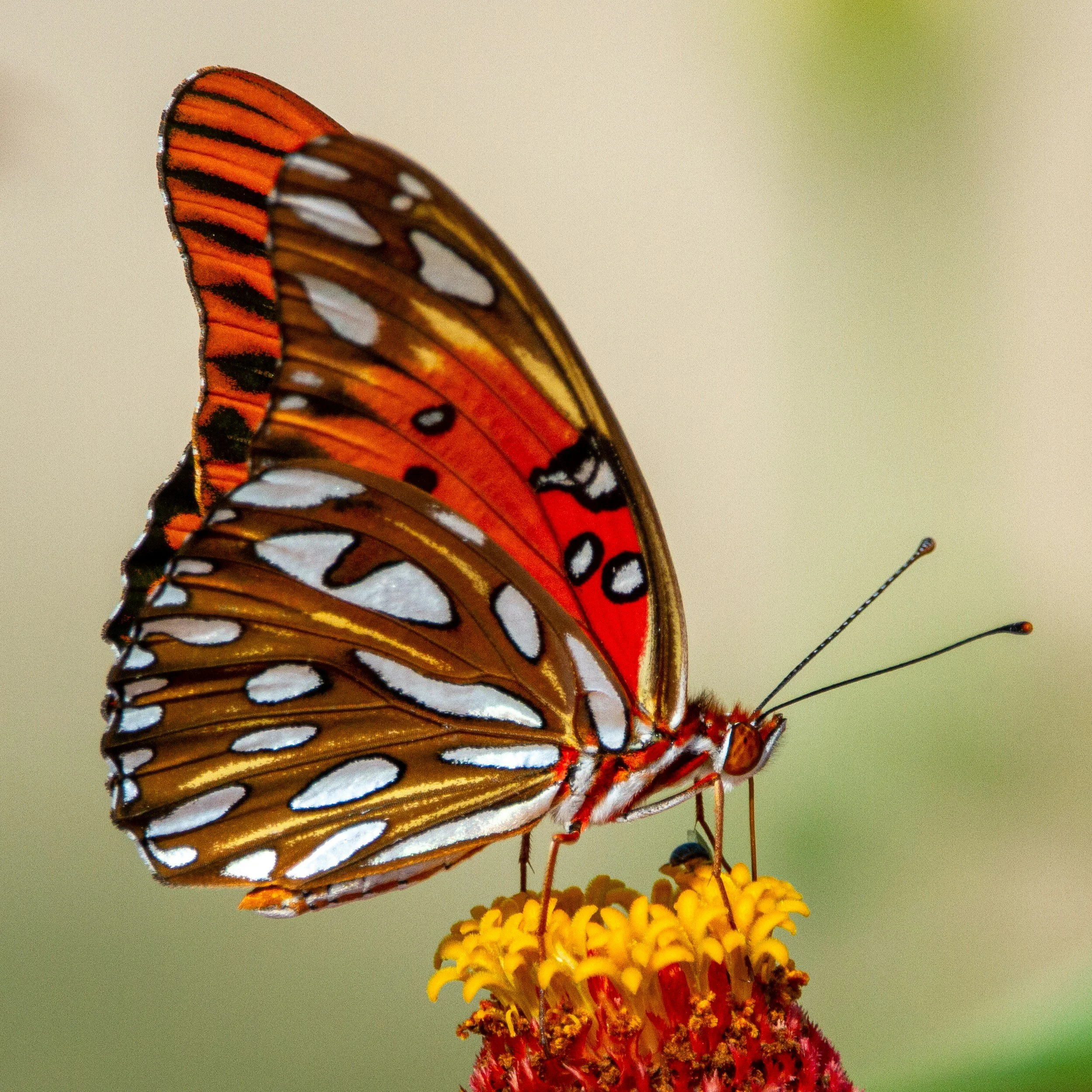
Every so often, one would flutter into our yard, wander about for a bit, then disappear. I was mesmerized! But as we had nothing growing in our yard to attract Gulf fritillaries, nor to encourage them to linger, sightings were rare and short-lived.
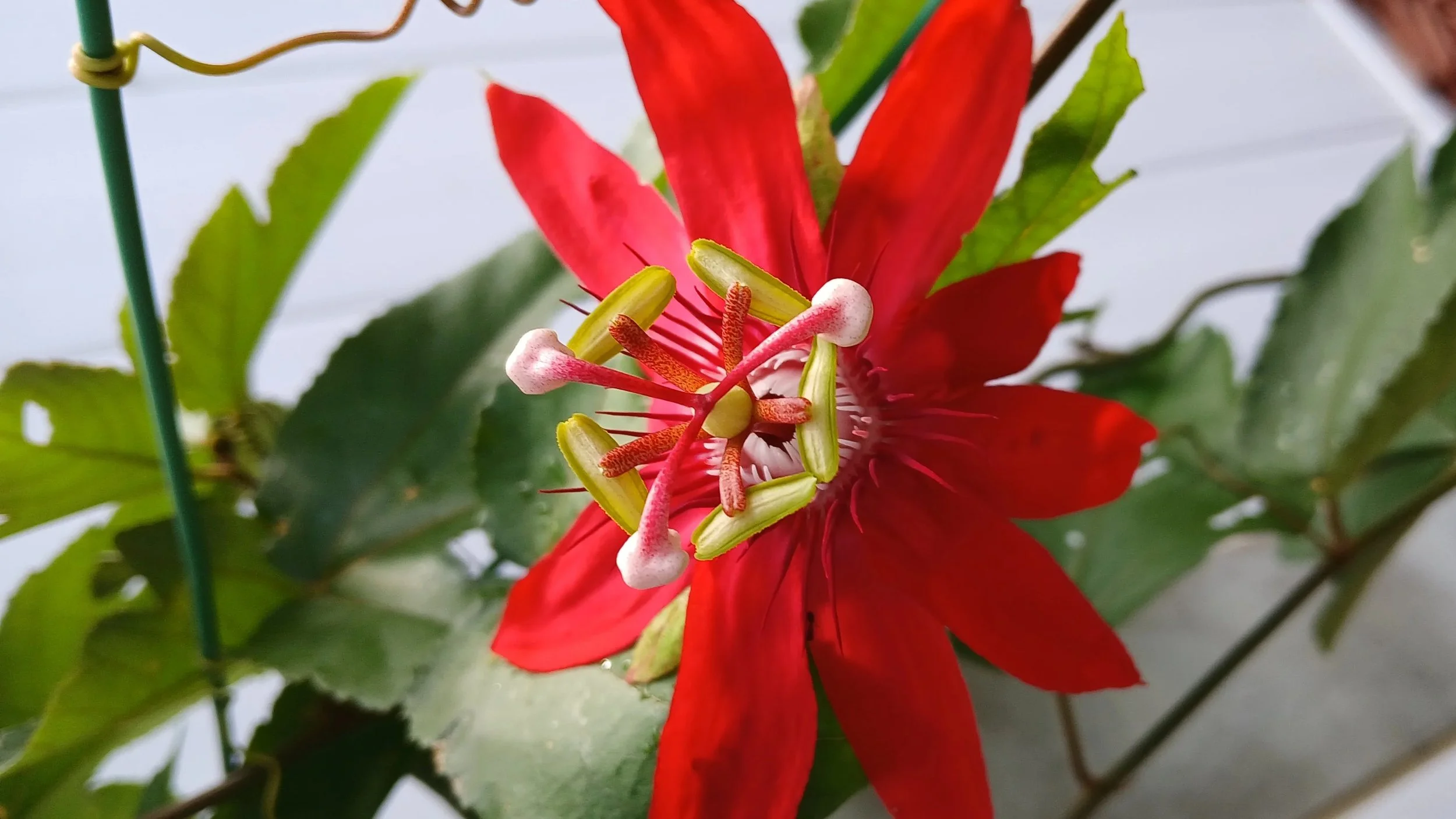
I learned that the host plant for Gulf fritillaries (the plant upon which they lay their eggs, so that their caterpillars can feed) is the passion vine. So early this spring, my husband Nathan helped me build a trellis, about 8 feet tall and 5 feet wide, just outside our back porch. Then I planted a red passion vine—my way of conveying to the Gulf fritillaries, “You’re welcome here, and we want to see more of you!”
I tended the passion vine fastidiously, fertilizing, watering, weeding, and guiding the branches upward. By summer, we had a lush, hearty vine, about 4 feet tall. And just as we’d hoped, the Gulf fritillaries started coming. One… then another… then another… then several at once! I was pleased as pie!
Shortly thereafter, the flowers started blooming—beautiful, bright red, and otherworldly! Before I knew it, I’d fallen in love with the vine as well!
Then came the caterpillars, because the reason the butterflies were visiting our vine was to lay their eggs on it…
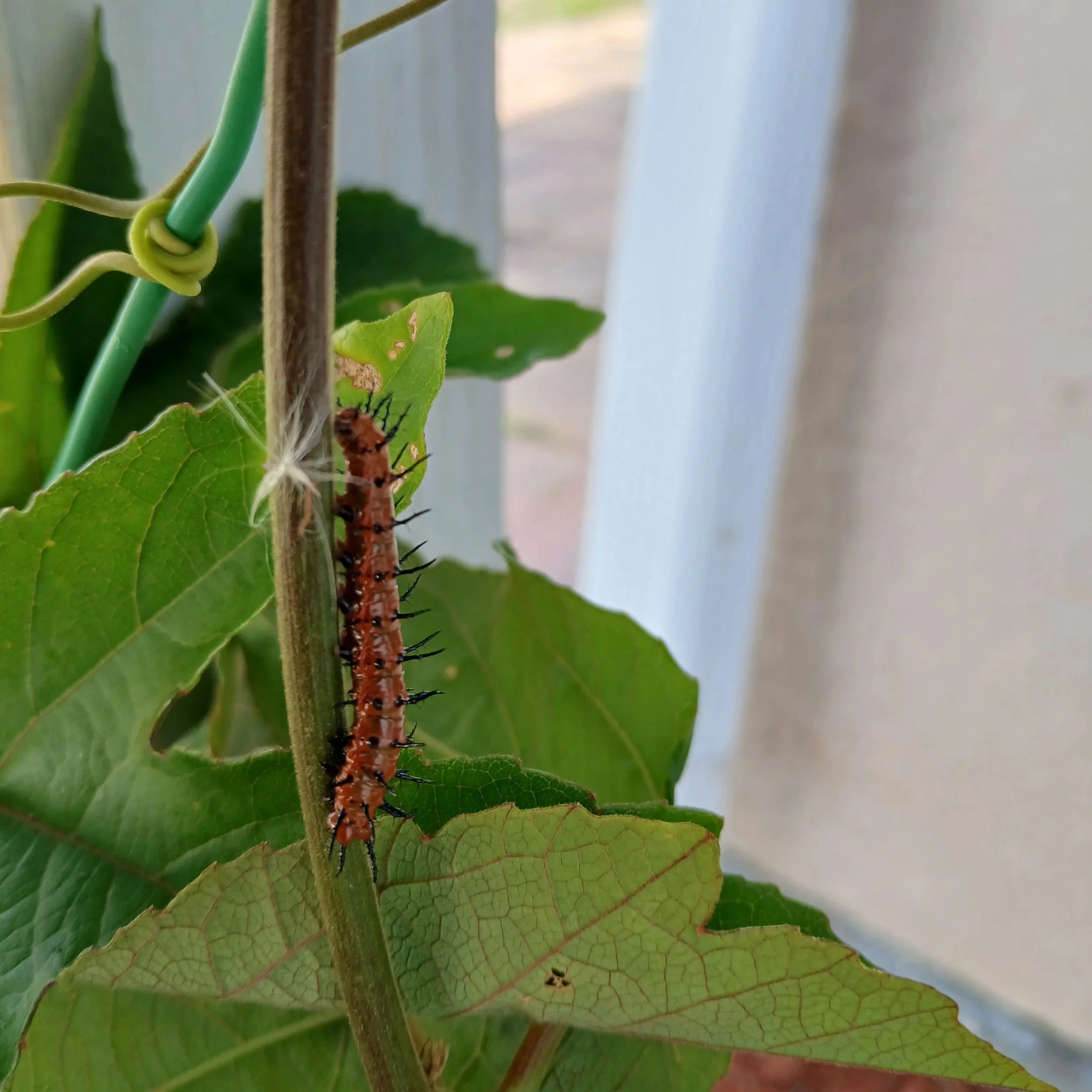
At first, I was excited by the prospect of the next generation of Gulf fritillary butterflies… that is until, as the caterpillars grew in size, so did their appetites. They munched on the leaves, the tendrils, the new growth on the branches… and then, to my horror, they discovered the flowers.
In a matter of days, the caterpillars had devoured every newly formed bud on the vine before a single one had had a chance to bloom. Despite the fact that these caterpillars were produced by and doing the work of the Gulf fritillaries, it was easy to mischaracterize them as “the enemy.”
Our once hearty vine was now looking rough, and I was dejected.
As I sat in our kitchen nook one morning, wistfully gazing at what was left of the vine, a Gulf fritillary fluttered over the fence and began weaving through the remaining branches of the vine, searching for the perfect spot to land. I rushed outside to hurry the butterfly along, because the last thing we needed right then was more caterpillar eggs!
A little while later, I glanced outside to see another Gulf fritillary, busily laying eggs on the vine. I let out a flustered sigh, then expressed my frustration to my husband who was making lunch in our kitchen: “Those butterflies are going to destroy that vine before it even has a chance to get established!”
I was just about to go shoo the butterfly away when my husband—my dear, sweet, wise husband—reined me back in with a simple question: “But didn’t you plant the vine so that the butterflies would come?”
He was right. I’d completely forgotten.
Somewhere in all of my toiling and the passage of time, I’d lost sight of the whole point. I’d planted the passion vine so that we could experience and enjoy the Gulf fritillaries more fully. Yet the Gulf fritillaries had become an afterthought, an inconvenience, and a nuisance to be handled, because I’d started loving the vine more than the butterflies.
I repented, right then and there. Not in a spiritual sense, because this wasn’t a sin issue; but I did have to change the way I thought about the vine moving forward. If I truly wanted to experience and enjoy the Gulf fritillaries more, I’d have to be willing to let the vine serve its purpose, even if it might be eaten up entirely. (Though, in the case of this particular passion vine, I am happy to say, now a couple months later, it is even taller and more lush than before, and we may even enjoy a few flowers again soon… if the caterpillars don’t eat them first.)
There’s spiritual application to this story, as I’m finding is true with so many human endeavors in God’s creation…
When people first encounter God, it’s normal to be mesmerized by Him and to want, more than anything, to know, experience, and enjoy Him more fully.
As we desire to encounter God more consistently in our lives, we usually seek out ways, or even create new ways, to facilitate those encounters with Him. These means of encountering God can look like all sorts of things—things that, in and of themselves, can be good, like…
Favorite Bible teachers or pastors
Specific denominations and churches
Seminaries or Christian schools
Doctrines
Christian books or podcasts
Bible studies or reading plans
Contemporary Christian music, hymns, or worship songs
Christian conferences
Christian organizations
Established ministries and church programs
Kids clubs
Youth camps
Traditions
Etc.
But what happens when whatever God is doing (or allowing to happen) begins to eat away at whatever “good thing” we’ve grown to love that has (in the past, at least) allowed us to encounter God, and to know and experience and enjoy Him more fully?
When we love that “good thing” too much, we might end up missing God entirely as we invest all of our time and energy and attention and adoration into helping the “good thing” grow bigger and stronger and more beautiful. Worse still, we might even find ourselves actively fighting against God, or trying to shoo Him away, mistaking His presence and activity as a problem to be dealt with, or (Lord have mercy on us) as “a spiritual attack from the enemy.”
When we begin to value the “passion vines” in our lives (the ministries we’re a part of, the teachers we listen to, the books we read, the songs we sing, etc.) more than the God whom we had intended to experience, enjoy, and know more fully because of them, it’s time for us to repent. It’s time to remember our first love, and to reset our priorities. It’s time to let God do what He needs to do, even if the “vine” gets utterly destroyed in the process.
Because it was never supposed to be about our “passion vines.” It was always supposed to be about seeing more and more of God, and living daily in awe of Him.
Love the Lord your God with all your heart, with all your soul, and with all your strength. - Deuteronomy 6:5 (CSB)
Dear children, keep away from anything that might take God’s place in your hearts. - 1 John 5:21 (NLT)
Want to read more articles like this one? Subscribe today for free, and you’ll get blog posts and updates sent straight to your inbox, so you’ll never miss a thing!
